
Investigating the water-food nexus and MAR/RBF for agrarian case study sites in North India
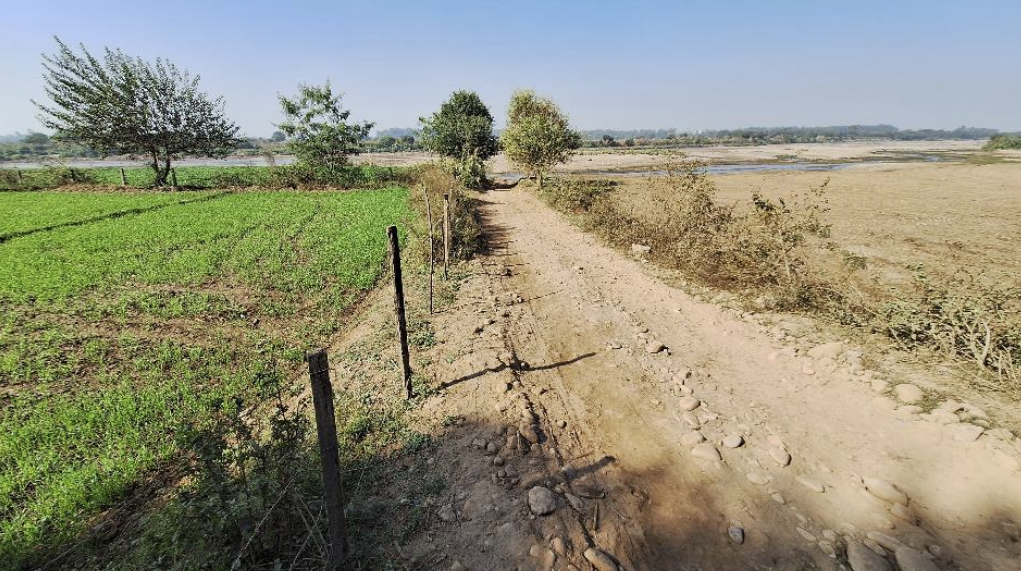
The great northern plains of the Indus-Ganga-Brahmaputra basin in North India are dominated by agriculture and are traversed by many perennial rivers and irrigation canals. However, some of these rivers are impacted by un- to partially treated domestic and industrial wastewater resulting in a degradation of water quality and consequently rendering them unsuitable for irrigation. At locations where the underlying alluvial aquifers are in hydraulic contact with the rivers, RBF could potentially be used to improve water quality for irrigation and consequently relieve the stress on groundwater resources.
As part of the German-Indian GIANT-SPARC project “Integration of managed aquifer recharge and water-food nexus in higher education”, HTW Dresden and IIT Roorkee are investigating the potential of MAR/RBF for irrigation at some sites in the states of Uttar Pradesh and Punjab. The investigations are being scientifically supported by the Nuclear Hydrology Laboratory at the National Institute of Hydrology in Roorkee and the TU Dresden’s Institute of Water Chemistry (https://lnkd.in/dHXfAfzU).
In this context, Dr. Cornelius Sandhu (HTW Dresden) and Mr. Rene Zippel (PhD researcher, TU Dresden) conducted field work and collected water samples from these sites in November/December 2025. Mr. Zippel was also assisted by Mr. Kartik Jadav and Mr. Ashish Koradia, PhD researchers from IIT Roorkee. They conducted extensive water quality monitoring of various rivers and riparian and groundwater wells. The aim of this monitoring program was to assess the potential of RBF for irrigation. General water quality parameters were determined directly on site. Samples were collected for various parameters, preserved appropriately for transport and subsequently analysed and evaluated by HTW Dresden and TU Dresden. Furthermore, water samples from a wastewater-impacted stream, bank filtrate and drinking water from another site were investigated for the detection of micro and nanoplastics using flow cytometry. These initial investigations aim to understand the impact of different water matrices on the analytical procedure.
Furthermore, Mr. Zippel gained insights into the work of various departments and their laboratories at IIT Roorkee and established contacts as a basis for future scientific cooperation. In addition to the scientific aspects, the stay also offered Mr. Zippel the opportunity to become acquainted with India’s culture and to gain valuable intercultural experience.